
Free Keyword Research Tool: The Ultimate Guide to Finding Keywords That Can Rank
Summarize this blog post with: ChatGPT | Perplexity | Claude | Grok
You’ve probably already seen how the right keywords can make a major difference to Google rankings, but effective keyword research does not require an expensive SEO subscription. The real challenge is knowing which free tools to use, which metrics to trust, and how to turn keyword ideas into realistic ranking opportunities. In this guide, you’ll learn how to conduct keyword research for free, evaluate search intent and competition, and build a practical SEO content strategy.
Key Takeaways
- Free keyword research tools help discover search terms, related queries, long-tail opportunities, and content ideas without requiring a paid subscription.
- Keyword relevance and search intent can matter more than search volume when choosing a target keyword.
- Long-tail keywords provide specific search intent and can create useful opportunities for newer or smaller websites.
- Google Keyword Planner, Google Trends, Google Search, and Search Console provide complementary keyword insights when used together.
- Keyword difficulty, search demand, competition, SERP characteristics, and business value should all influence keyword selection.
- Keyword clustering organizes related search terms into comprehensive topics instead of creating separate pages for every variation.
- A repeatable workflow should connect discovery, validation, content creation, publishing, internal linking, and performance monitoring.
What Is a Free Keyword Research Tool?
A free keyword research tool is a software platform or online service that helps users discover, evaluate, and organize keywords for SEO without requiring a paid subscription. These tools can reveal keyword ideas, related searches, search demand, competition, questions, trends, and other information useful for planning content.
Moreover, keyword research involves discovering relevant search terms, analyzing their search intent and competition, and prioritizing the keywords that best match a website’s audience and business goals. For example, someone targeting a local SEO agency may discover broader terms such as digital marketing, but a phrase like digital marketing agency in Nagpur may have much stronger commercial relevance.
What Data Does a Keyword Research Tool Provide?
A keyword research tool can provide different metrics depending on the platform. Common metrics include:
- Search volume: Estimated number of searches for a keyword.
- Keyword difficulty: An estimate of how difficult it may be to rank organically.
- Competition: Often indicates advertiser competition rather than organic SEO difficulty.
- CPC: Average cost-per-click data useful for understanding commercial value.
- Search intent: The underlying reason behind a search.
- Related keywords: Similar or semantically connected search terms.
- Long-tail keywords: More specific phrases containing multiple words.
Importantly, no single free keyword research tool provides every metric with equal depth. Google Keyword Planner focuses strongly on advertising-related keyword data, Google Trends focuses on relative search interest, while Search Console shows queries for which your own website already appears.
Why Is Keyword Research Important for SEO?
Keyword research is important for SEO because it helps you understand what people search for and align content with those searches. Instead of creating content based entirely on assumptions, keyword research gives you evidence about topics, questions, demand, and user behavior.
For example, a business selling solar panels could target solar panels, but a more specific phrase such as rooftop solar subsidy in Maharashtra may reveal a different and potentially more useful audience.
Google’s SEO guidance recommends creating useful, people-first content and understanding the words users may search when looking for information. Google also notes that its language systems can understand how pages relate to many queries without requiring every exact keyword variation. — Source: [Google Search Central, 2026]
Why Search Volume Alone Is Not Enough
Search volume measures demand, but it does not measure whether a keyword is valuable for your business. A high-volume keyword can be extremely broad, competitive, or disconnected from your products and services.
For example, SEO may attract significantly more searches than SEO agency in Nagpur, but the local phrase can have stronger commercial intent for an agency serving Nagpur.
The best keyword is not necessarily the keyword with the highest search volume; relevance, search intent, competition, ranking potential, and business value should also influence keyword selection.
How Can You Do Keyword Research for Free?
You can do keyword research for free by combining search suggestions, Google data, competitor SERPs, trends, and your own Search Console data. A multi-tool workflow is usually more useful than depending on one platform.
1. Start With a Seed Keyword
A seed keyword is a broad phrase that describes your main topic, product, service, or audience problem. For example, digital marketing can be the seed keyword for an agency researching new content opportunities.
Start with three to five seed keywords rather than just one. This creates a broader pool of related keyword ideas.
2. Generate Keyword Ideas
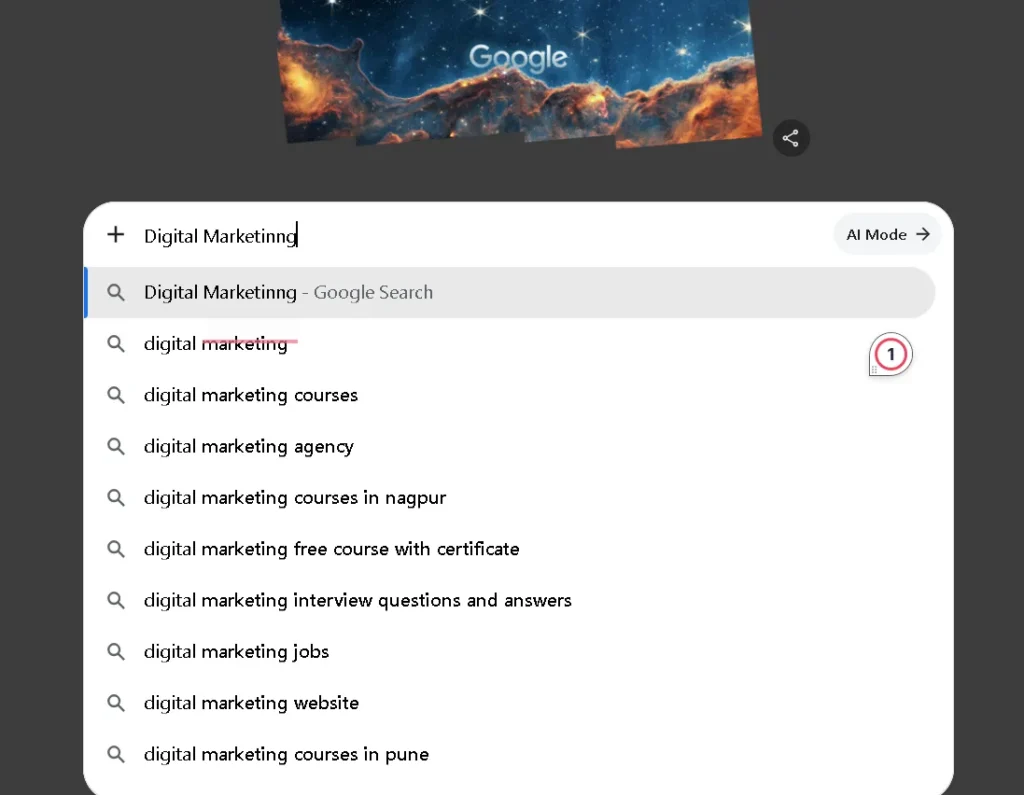
Keyword generation means expanding a seed keyword into related phrases, questions, modifiers, and specific searches. Google Autocomplete is useful because its predictions reflect real searches and are influenced by factors such as language, location, trending interest, and previous searches. — Source: [Google Search Help, 2026]
For example, search digital marketing and test modifiers such as:
- digital marketing for small business
- digital marketing agency
- digital marketing services
- digital marketing course
- digital marketing strategy
- digital marketing in Nagpur
3. Find Long-Tail Keywords
Long-tail keywords are specific search queries that usually contain several words and can reveal clearer search intent than broad keywords.
For example, SEO is broad, while how to improve local SEO for a small business communicates a much clearer need.
You can find long-tail keywords using Google Autocomplete, People Also Ask, related searches, question-based keyword generators, Google Trends, and free SEO keyword tools.
4. Analyze Search Intent
Search intent describes the underlying goal a user has when entering a search query, such as learning information, finding a specific website, comparing options, or completing a transaction.
For example, what is PPC is informational, while best PPC agency in Nagpur is commercial investigation and hire PPC agency Nagpur is closer to transactional intent.
5. Validate the SERP
SERP analysis means studying the actual Google results for a keyword before deciding whether to target it. Look at the ranking pages, content formats, featured snippets, local packs, videos, forums, product results, and AI-generated search features.
For example, if nearly every result for SEO audit is a comprehensive guide from established websites, a new website may need a more focused angle rather than publishing another generic definition.
6. Group Related Keywords
Keyword clustering means grouping closely related search terms into one topical content asset. For example, keyword research tool, free keyword research tool, keyword research for SEO, and keyword generator can potentially support one comprehensive page when their intents overlap.
7. Prioritize Keywords
Keyword prioritization ranks opportunities according to relevance, intent, demand, competition, SERP characteristics, and business value.
A simple scoring framework is:
Priority = Relevance + Intent + Business Value + Ranking Potential − Competition
You do not need a complicated formula. The objective is to avoid selecting keywords simply because a tool displays a large search-volume number.
What Are the Best Free Keyword Research Tools?
The best free keyword research tools are Google Keyword Planner, Google Trends, Google Search and Autocomplete, Google Search Console, free keyword generators, and limited-free SEO platforms. Each tool answers a different research question, so combining them usually produces better results.
| Tool | Best For | Keyword Ideas | Search Data | Main Limitation |
|---|---|---|---|---|
| Google Keyword Planner | Search demand and commercial research | Yes | Yes | Designed around Google Ads |
| Google Trends | Trends and regional interest | Yes | Relative | Does not provide standard monthly volume |
| Google Search/Autocomplete | Real-world query ideas | Yes | No standard volume | Limited quantitative metrics |
| Google Search Console | Existing-site keyword opportunities | Actual queries | Actual impressions/clicks | Only your site’s data |
| AnswerThePublic | Questions and content ideas | Yes | Limited/free access varies | Free access is limited |
| Ahrefs Free Keyword Generator | Keyword ideas | Yes | Selected metrics | Free scope is limited |
| Semrush Free Keyword Tool | Keyword ideas and core metrics | Yes | Yes | Free usage is limited |
Is Google Keyword Planner Free for Keyword Research?
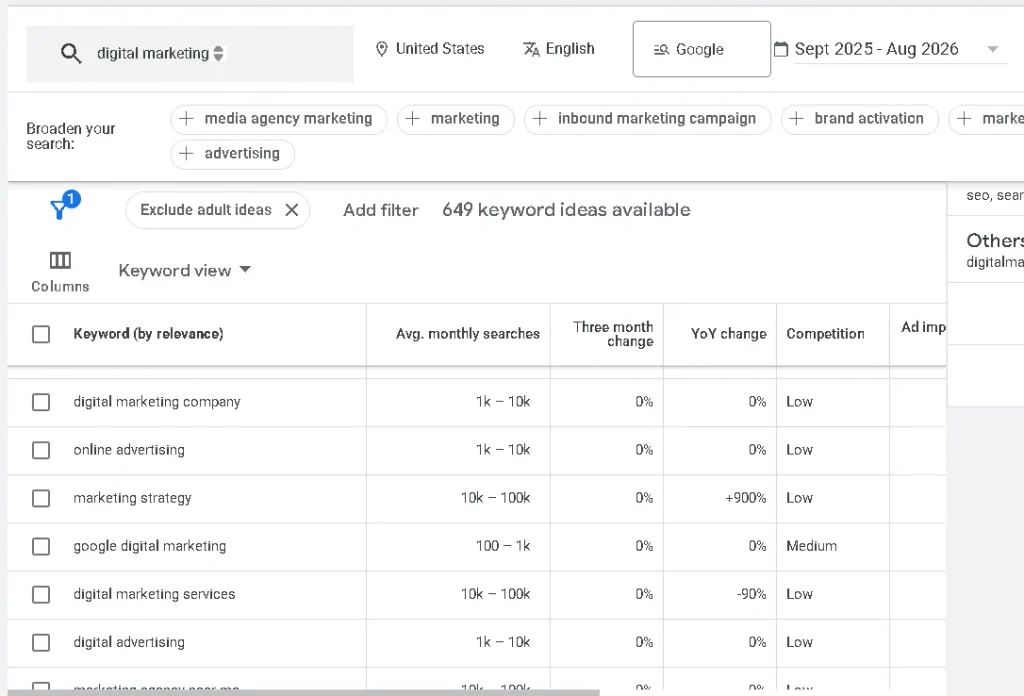
Google Keyword Planner is a free Google Ads tool that can be used to discover keyword ideas, monthly search estimates, and advertising cost information. Google says Keyword Planner can discover keywords related to a business and provide estimates of searches and costs.
However, access currently involves setting up a Google Ads account and entering billing information for basic Keyword Planner functionality. Google distinguishes Keyword Planner from actually running paid campaigns, so researchers should understand the account requirements before treating it as a completely account-free tool. — Source: [Google Ads Help, 2026]
How Can Google Trends Help With Keyword Research?
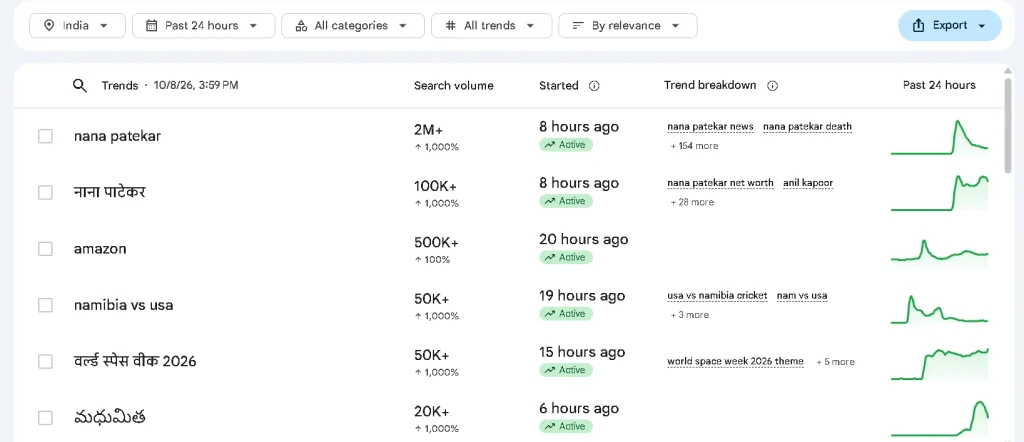
Google Trends helps you compare relative search interest across terms, locations, and time periods. Its data is normalized to a 0–100 scale, meaning the numbers represent relative popularity rather than absolute search volume. — Source: [Google Trends Help, 2026]
For example, you can compare solar panels with solar subsidy in India to determine whether interest changes seasonally or geographically.
Can Google Search Console Be Used for Keyword Research?
Google Search Console can be used for keyword research because it shows the queries that generate impressions and clicks for your website. The Performance report includes clicks, impressions, CTR, average position, and query-level data. — Source: [Google Search Console Help, 2026]
For example, a page targeting SEO services might unexpectedly receive impressions for SEO services for small businesses. That query can become a supporting section, FAQ, or even a separate page if the intent is sufficiently different.
Which Free Keyword Research Tool Is Best for Beginners?
Google Search combined with Google Trends and Search Console is one of the simplest free keyword research workflows for beginners. It provides query ideas, trend context, and actual performance data without requiring a complex SEO platform.
For users who want dedicated keyword suggestions, Ahrefs provides a free Keyword Generator, while Semrush provides free keyword-research functionality with limits. Ahrefs currently describes its free Keyword Generator as providing keyword ideas from a database of more than 8 billion queries, while its broader free account has ongoing limits. — Source: [Ahrefs, 2026]
Semrush also offers free keyword research tools with keyword ideas and metrics such as search volume, keyword difficulty, CPC, and intent, subject to free-access limitations. — Source: [Semrush, 2026]
How Do You Choose the Right Keyword to Target?
You choose the right keyword by balancing relevance, search intent, demand, competition, SERP characteristics, ranking potential, and business value.
What Is the Difference Between Search Volume and Keyword Difficulty?
Search volume estimates how much a keyword is searched, while keyword difficulty estimates how challenging it may be to rank for that keyword. These metrics answer different questions and should not be treated as interchangeable.
For example, a keyword with 10,000 estimated monthly searches may be harder to rank for than a keyword with 300 searches. The smaller keyword can still generate more valuable traffic if its intent closely matches your offer.
How Do You Find Low-Competition Keywords for Free?
You can find low-competition keywords by combining specific long-tail queries with SERP analysis and your own website data.
Look for keywords where:
- The search intent closely matches your content.
- Ranking pages have weak or outdated content.
- Search results include smaller websites.
- The query is highly specific.
- Your website already has topical authority.
- Search Console shows impressions for related terms.
Importantly, low keyword difficulty does not automatically mean low business competition. A keyword can be easy to rank for but have little commercial value.
What Types of Keywords Should You Find With Free Tools?
Keyword types describe different ways users search based on intent, specificity, branding, location, or buying stage.
| Keyword Type | Example | Typical Intent |
|---|---|---|
| Informational | what is SEO | Learn |
| Commercial | best keyword research tool | Compare |
| Transactional | buy SEO software | Convert |
| Navigational | Google Search Console | Find a website |
| Local | SEO agency in Nagpur | Find a local provider |
| Branded | Semrush keyword tool | Brand-specific |
| Non-branded | free SEO tool | General discovery |
| Question-based | how to find keywords | Learn |
| Long-tail | free keyword research tool for bloggers | Specific need |
For example, what is SEO is primarily informational, while SEO agency in Nagpur has local commercial intent. Similarly, best free keyword research tool indicates that the user is comparing options.
How Do You Find Keyword Ideas From Google Search Results?
You can find keyword ideas directly from Google Search by studying Autocomplete, People Also Ask, related searches, and the language used by ranking pages.
First, enter your seed keyword into Google. Then examine the questions and related searches surrounding the main results.
For example, searching keyword research tool may reveal variations involving free tools, SEO, long-tail keywords, search volume, and beginner workflows.
[Insert image: Google SERP showing People Also Ask and related searches | Alt text: “Find keyword ideas from Google Search results”]
Google Autocomplete is particularly useful because its predictions reflect real searches while also considering language, location, trending interest, and other factors. — Source: [Google Search Help, 2026]
What Is a Practical Free Keyword Research Example?
A practical keyword research example starts with a broad seed keyword and gradually narrows it into specific opportunities with clearer intent.
Suppose you are marketing a digital marketing agency in Nagpur.
Start with:
Seed: digital marketing
Next, expand it into:
- digital marketing agency
- digital marketing services
- digital marketing for small business
- digital marketing agency in Nagpur
- SEO and digital marketing agency Nagpur
- how does digital marketing work
- best digital marketing strategy for small business
Now classify the intent.
Informational: how does digital marketing work targets users seeking education.
Commercial: best digital marketing agency in Nagpur targets users comparing providers.
Local: digital marketing agency in Nagpur indicates geographic intent.
Service-focused: digital marketing services for small business indicates a specific business need.
The important lesson is that keyword research should move from broad topics toward specific user problems and business opportunities.
How Do You Turn Keyword Research Into an SEO Content Strategy?
You turn keyword research into an SEO content strategy by clustering related keywords, mapping them to pages, creating comprehensive content, and connecting pages through internal links.
Build Topic Clusters
A topic cluster is a group of related pages organized around a central subject. For example, a pillar page about SEO can connect to supporting pages about keyword research, technical SEO, on-page SEO, internal linking, and local SEO.
Map Keywords to Search Intent
Keyword mapping assigns each important keyword or keyword cluster to the page that best satisfies its search intent. Avoid creating separate pages for every tiny keyword variation when one comprehensive page can satisfy the same user need.
For example, free keyword research tool, free SEO keyword research tool, and keyword suggestion tool may overlap enough to support one strong guide.
Strengthen Internal Links
Internal linking connects related pages so users and search engines can discover supporting content more efficiently. A keyword research guide could link to an on-page SEO checklist, search intent guide, and long-tail keyword guide.
Google recommends creating content that is useful, well organized, original, reliable, and written for people rather than primarily for search engines. — Source: [Google Search Central, 2026]
How Do You Check Keyword Performance After Publishing?
You can monitor keyword performance in Google Search Console by analyzing queries, impressions, clicks, CTR, and average position.
First, open the Performance report and select Queries. Then look for keywords that generate impressions but receive few clicks.
Google explains that Search Console can show the queries that led users to your website and help identify opportunities for improving SEO. — Source: [Google Search Console Help, 2026]
For example, if your page receives 500 impressions for free SEO tools but has a low CTR, you could test a more relevant title and description.
What’s Next: How Do You Build a Repeatable Free Keyword Research Workflow?
A repeatable free keyword research workflow follows eight stages: discover, validate, group, prioritize, create, publish, monitor, and update.
- Discover: Use Google Search, Autocomplete, Keyword Planner, Trends, and keyword generators.
- Validate: Check search intent, SERPs, demand, and competition.
- Group: Cluster closely related keywords.
- Prioritize: Consider relevance and business value.
- Create: Build content that directly satisfies the search intent.
- Publish: Optimize titles, headings, internal links, and on-page elements.
- Monitor: Review Search Console impressions, clicks, CTR, and queries.
- Update: Expand sections based on new queries and changing search behavior.
Google Search Console’s query reports can reveal both expected and unexpected searches that lead to your website, making the platform valuable for finding content opportunities after publication. — Source: [Google Search Console Help, 2026]
how to improve Google rankings
Keyword research is not a one-time activity; it becomes more valuable when actual performance data feeds the next round of research.
Conclusion
Free keyword research tools can provide enough information to build a strong SEO strategy when you use them strategically. You do not need to depend on one expensive platform to discover useful keywords, understand search intent, validate opportunities, and monitor performance.
Instead, combine Google Search for real query ideas, Keyword Planner for search-demand estimates, Trends for relative interest, Search Console for your own performance data, and reputable free SEO tools for additional keyword suggestions.
Most importantly, the goal of keyword research is not to collect the largest possible list of keywords; it is to identify the searches your audience cares about and create the best content for those searches.
Start with one seed keyword today. Discover its variations, validate the SERP, group related terms, choose the strongest opportunity, and turn that research into genuinely useful content.
Written by Roshan Julme — SEO Specialist with 4+ years of experience in SEO, digital marketing, keyword research, content strategy, and organic search optimization.
Reviewed by Roshan Julme — SEO Specialist, reviewing keyword selection, search-intent analysis, SEO strategy, and practical keyword-research methodology.
Disclaimer: This article was initially drafted using AI assistance. However, the content has undergone thorough revisions, editing, and fact-checking by human editors and subject matter experts to ensure accuracy.